Analysis with context
Agents, Syslog and integrations feed decoders and rules. Acceptance must demonstrate interpretation, correlation and the alert destination.
Centralize security events, track critical changes and investigate vulnerabilities with an open SIEM and XDR platform. Actual coverage depends on well-integrated sources, tuned rules and an operations team ready to act.
Add Solution assesses architecture, integrations, retention, security and acceptance criteria to build a project aligned with your infrastructure and risks.

Wazuh combines log analysis, integrity monitoring, configuration assessment, inventory and vulnerability detection. The platform can form a central monitoring and investigation layer while retaining the specialized controls that each environment still needs.
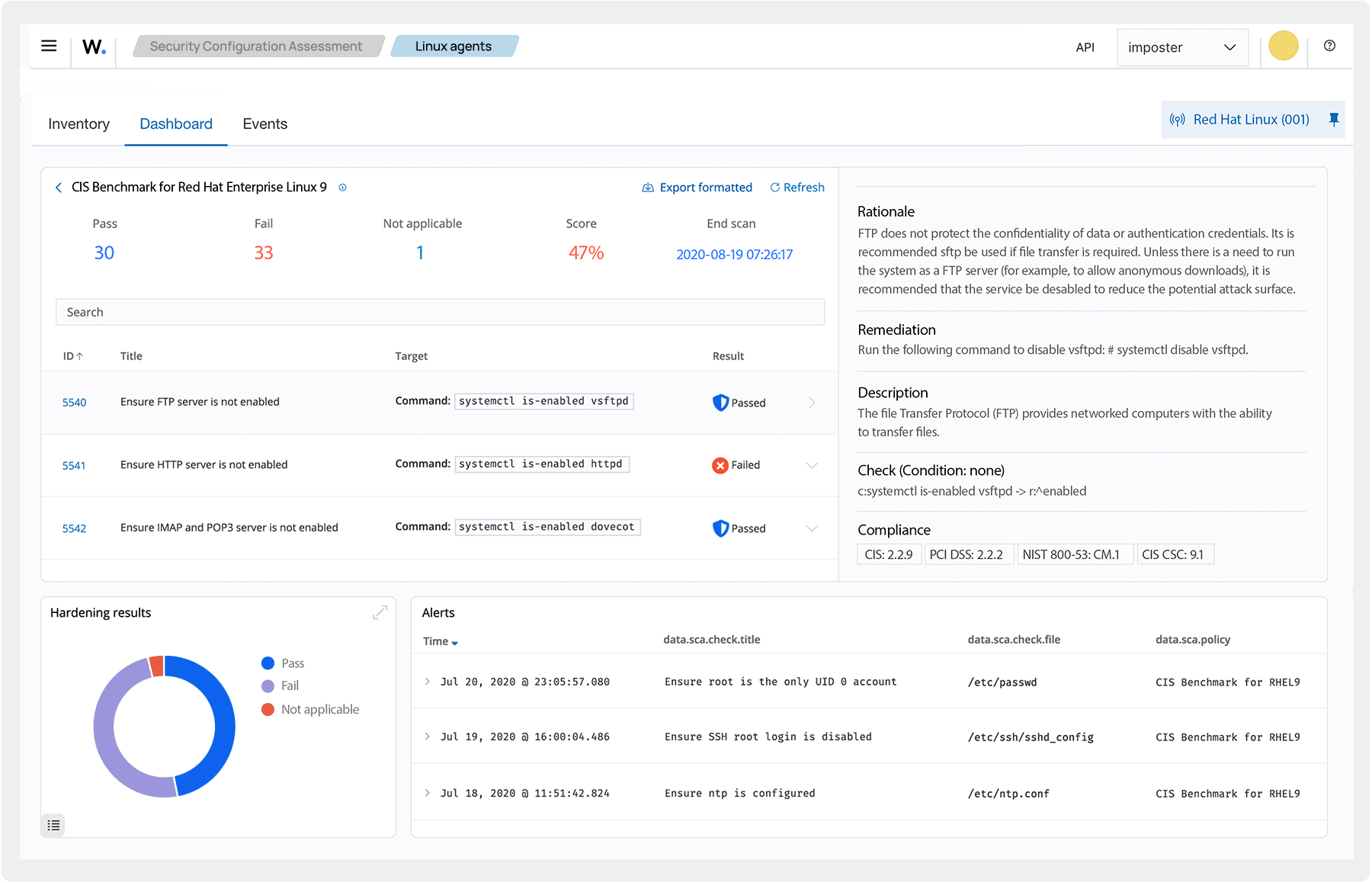
Official configuration assessment example with checks, results, rationale, remediation and references. Features and coverage vary by version, policy, system and configuration.
Agents, Syslog and integrations feed decoders and rules. Acceptance must demonstrate interpretation, correlation and the alert destination.
Hashes, attributes and changes in selected paths, with care around noisy directories and operating-system-specific limits.
Assessment policies guide remediation; they do not apply fixes or certify compliance on their own.
Syscollector provides context and the module correlates software with known vulnerabilities, subject to source coverage and updates.
SIEM/XDR describes the platform's scope. It does not imply automatic equivalence with any EDR, antivirus, NDR or SOC service.
The Wazuh server analyzes events and coordinates agents. Filebeat forwards alerts to the indexer; the indexer stores and searches; the dashboard provides investigation and administration. The server API has its own access flow.
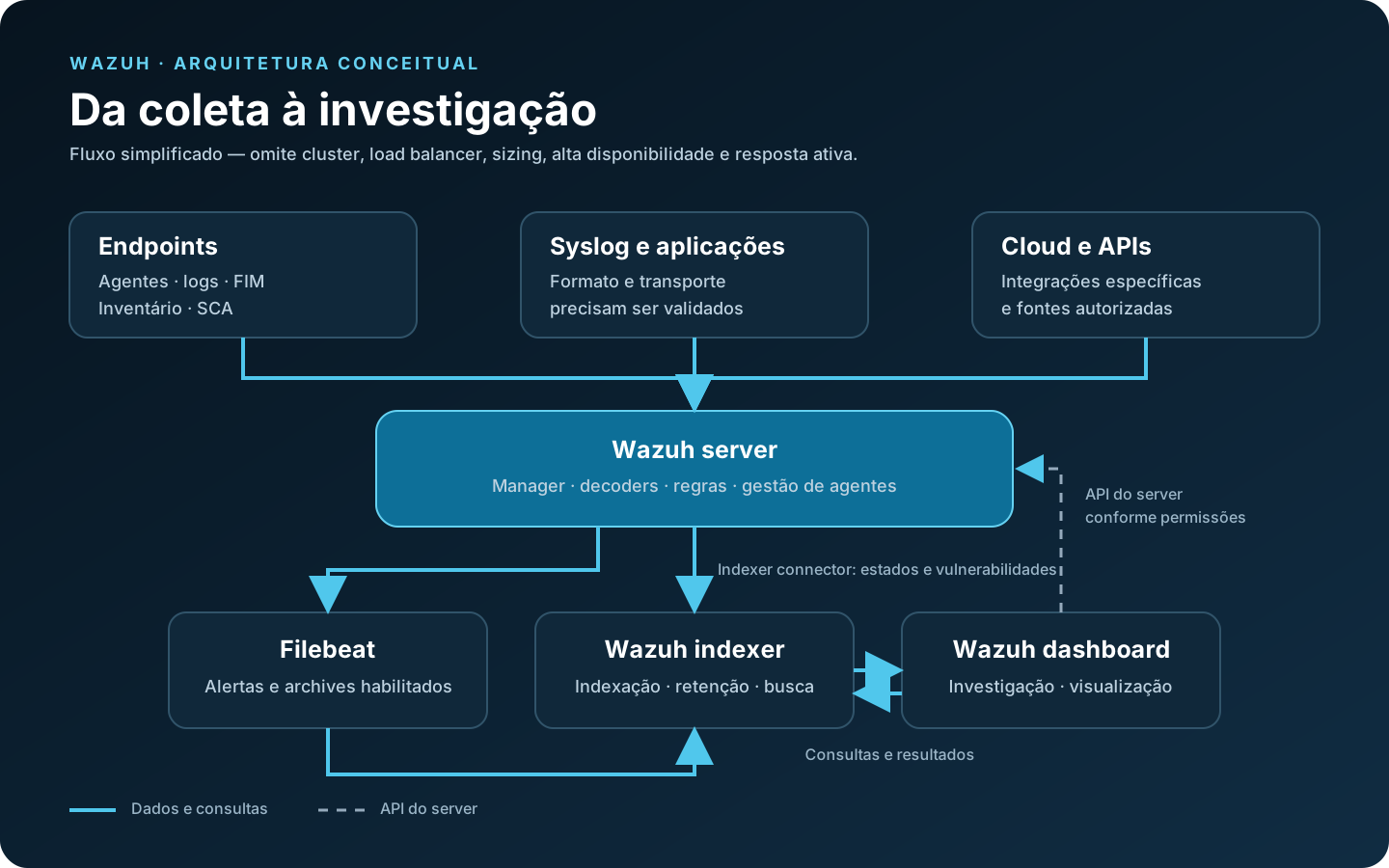
The flow shows configured sources, Wazuh server, Filebeat, indexer connector, Wazuh indexer, dashboard and separate access to the server API. It omits clustering, load balancing, sizing, high availability and active response; it does not represent a deployment.
Agents, Syslog, clouds, applications and integrations according to validated coverage.
Reception, decoding, rules, analysis and agent coordination.
Indexing, search, retention and capacity sized according to the data.
Queries, investigation and administration with controlled access.
Receiving a log file is not enough. User, origin, outcome and time must be interpreted; positive and negative rules must be tested with sanitized samples.
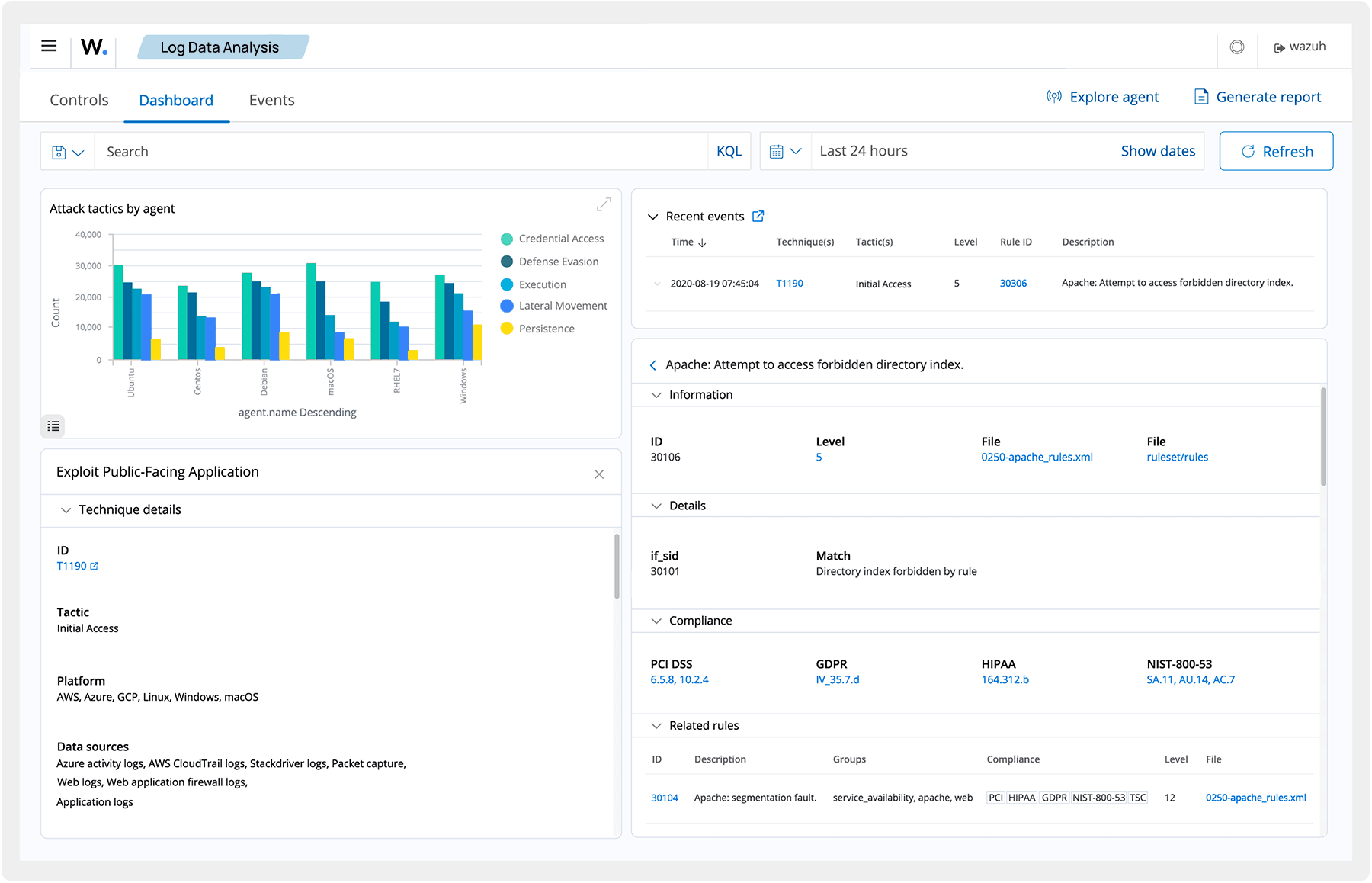
Official log analysis example with events, rules, tactics and investigation details. Its usefulness depends on the environment's sources, parser, rules and tests.
Consistent fields support custom rules and combinations of events within time windows.
Linking alerts to techniques helps investigation but does not prove complete coverage of a technique or campaign.
Actions require a target, exceptions, permissions, approval and rollback; a false positive can affect availability.
Reputation and enrichment require appropriate terms, curation and assessment of the data sent to the provider.
Agents provide local telemetry; Syslog serves equipment; APIs and specific modules connect external services. Agentless covers bounded scenarios without automatically reproducing the agent's inventory, FIM and execution context.
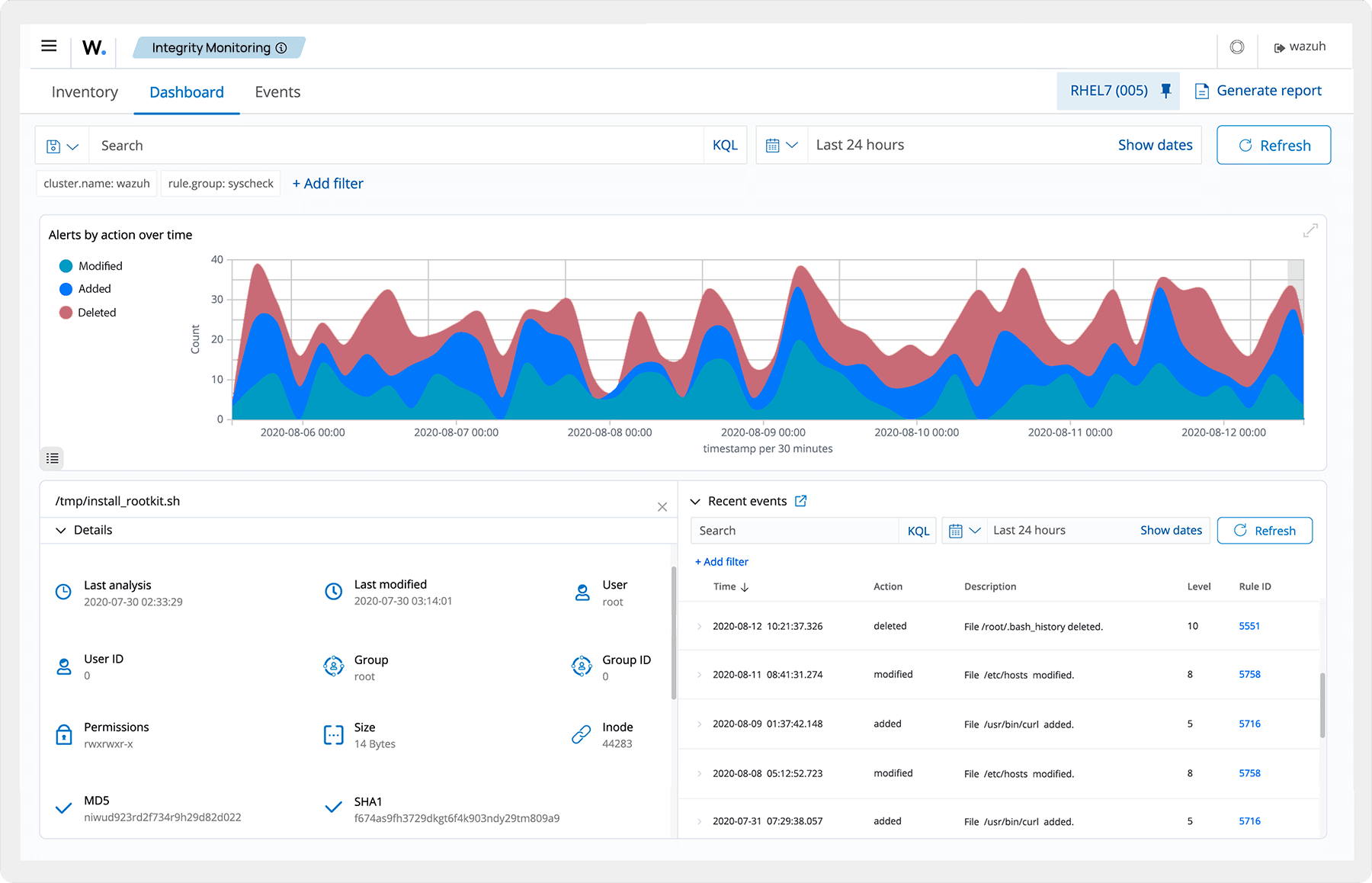
Official File Integrity Monitoring example with changes, users, hashes and recent events. Coverage must not be extrapolated to any file, system or share.
Events, inventory, integrity and configurations vary by system and policy.
Normalization and rules determine whether a received message becomes evidence that can be investigated.
Permissions, API limits, latency, cost and scope must be included in acceptance criteria.
Feasibility depends on data access, a stable format and events that can represent the use case.
The project must measure daily growth, peaks, average size, indexed alerts, archived data, replicas and backups. High-volume sources can dominate storage and processing.
Which data comes in and at what rate.
Variations and events per second.
Searchable period and archives.
Availability and storage cost.
RPO, RTO and tested restoration.
Retention without a policy can exhaust capacity. Deleting without validating requirements can eliminate necessary evidence.
TLS, certificates, RBAC, SAML, APIs and credentials must be treated as part of the project. Validation includes allowed and denied access, rotation and behavior when an identity dependency fails.
Permissions for data, operations and agents must be combined and tested.
Flow protection, certificate lifecycle and trust between components.
Least privilege, appropriate storage, rotation and an audit trail.
With self-managed deployment, the team and infrastructure take on installation, upgrades, capacity, backup and recovery. With Wazuh Cloud, the managed offering simplifies part of the platform, but retention, limits, integrations, API access and the division of responsibilities must be checked against the purchased plan.
Topology, sizing, upgrades, security, observability of the platform itself and continuity remain within the customer/project scope.
Capacity and features depend on the current offering; do not assume unrestricted access, infinite retention or operational equivalence.
Add Solution can structure discovery, architecture, integration, rules, retention, security, testing, documentation and operational handover. Each stage must be bounded according to the environment and the contracted service.
Assets, sources, risks, owners and use cases.
Components, networking, capacity, security and continuity.
Agents, Syslog, APIs, parsers and destinations.
Rules, exceptions, severity and controlled automation.
Positive and negative tests, failures and recovery.
Runbooks, ownership, triage, escalation and evolution.
A version is engineering context, not a permanent promise. Examples and “current” pages may differ; before deployment, confirm patch compatibility between core components, release notes, advisories and documentation for the actual version.
Clear answers, with limits that prevent incorrect technical and commercial expectations.
Equivalence should not be assumed. Wazuh combines detection and response functions and analyzes events from protection tools, but runtime prevention, isolation, investigation and tamper protection must be compared and tested in the environment.
The platform can support a SOC. People, hours, triage, escalation, containment authorization and response processes must be defined; installing the software does not automatically create a 24x7 operation.
The module identifies exposure to known vulnerabilities. Remediation depends on an update, configuration change or other approved treatment and must be verified at the source and in the inventory.
Not always. Syslog, APIs and agentless serve specific scenarios but do not automatically provide the same inventory, FIM and execution context as a compatible agent.
It depends on volume, peaks, retained data, the searchable period, replicas and backups. A pilot should measure daily growth; estimating only by endpoints can undersize high-volume sources.
SAML integration and role-based control are available. The design must combine permissions for data, operations and agents, including denied-access tests through the interface and API.
There are options for restricted networks and an offline repository. The project must define updates for packages, intelligence and integrations; isolation does not keep threat data current without a feed.
No. Availability depends on the design and testing of each layer. Failure of a worker, master, indexer or identity provider has different effects.
It can produce useful evidence and technical controls. Compliance also depends on purpose, governance, processes and assessment of applicable requirements; reports do not amount to certification or a legal guarantee.
Consider infrastructure or subscription costs, storage, integrations, detection engineering and operations. Compare total cost with coverage, maintenance and the actual capacity to investigate alerts.
Discuss sources, architecture, rules, retention, security, Wazuh Cloud and acceptance criteria for your environment.