Discover the real environment
Combine discovery mechanisms to reduce blind spots across networks, cloud and endpoints.
Add Solution uses Lansweeper to build visibility across complex technology environments, turning asset discovery into reliable information for IT operations, cybersecurity, asset management and decision-making.
From traditional infrastructure to remote endpoints, cloud, IoT and OT environments, we design discovery, inventory, normalization and integration strategies that reveal the real environment — including what was not documented.
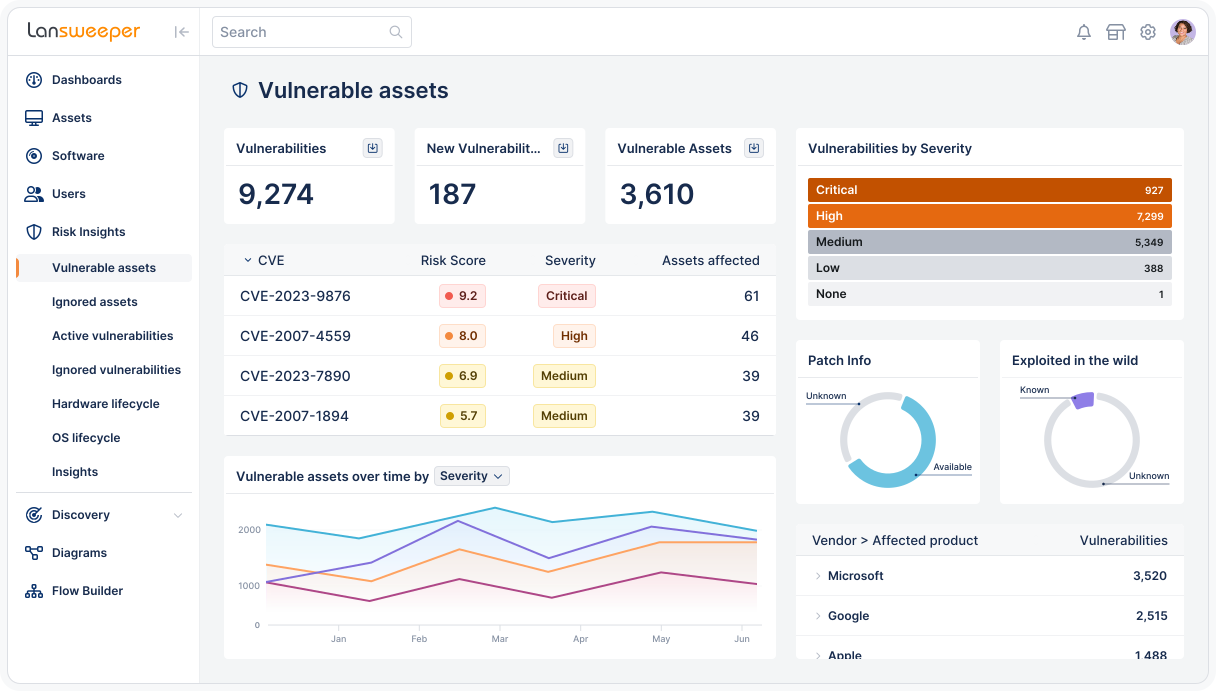

Manual inventories, spreadsheets, outdated CMDBs and isolated sources often represent only part of the environment. Continuous discovery narrows the gap between the documented and actual environments.
Infrastructure, servers, workstations and network devices.
Operational assets addressed with a strategy appropriate to the environment.
Resources distributed across providers and services.
Endpoints that do not remain within the corporate perimeter.
Consolidated, normalized and contextualized data.
An asset missing from the inventory still exists. It is simply outside your visibility.
Lansweeper automates discovery and centralization of technology asset data, building a unified view of IT, OT, cloud, IoT and remote endpoints. Hardware, software, users, configurations, lifecycle and vulnerability context become part of a living information base.
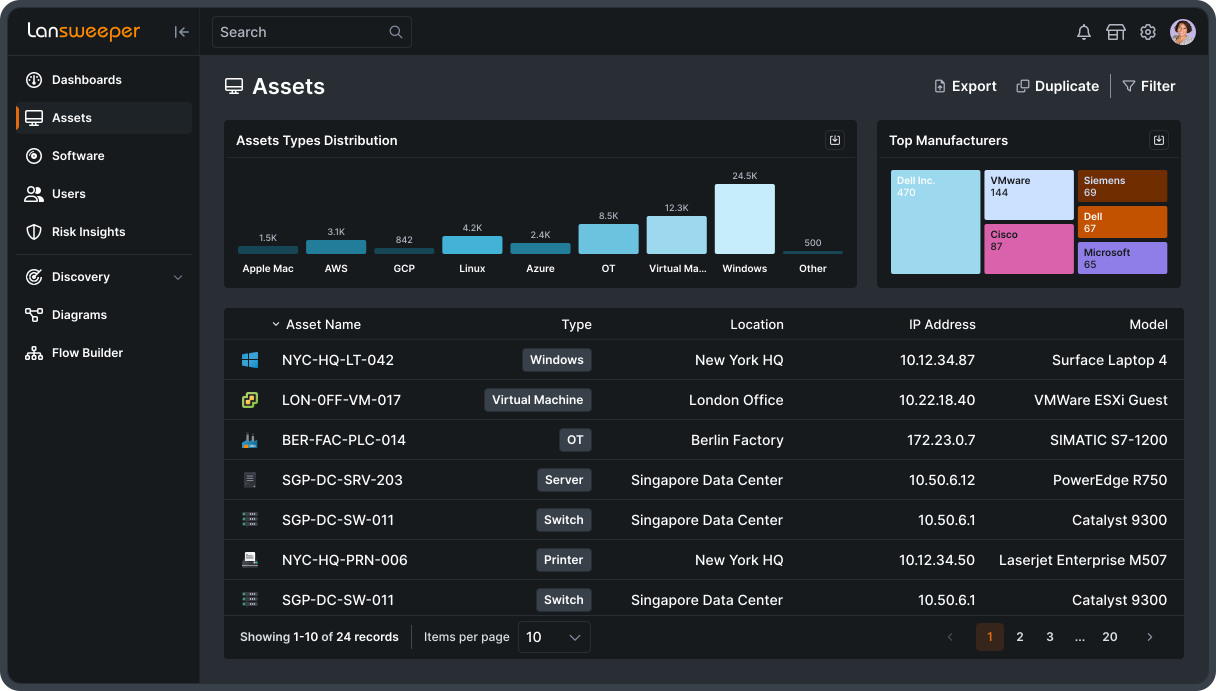
Combine discovery mechanisms to reduce blind spots across networks, cloud and endpoints.
Keep asset data organized and continuously updated.
Relate hardware, software, users, configurations, lifecycle and risk.
Support operations, security, compliance, planning and lifecycle management.
Connect reliable data to APIs, integrations, systems and workflows.
Decisions require knowing what each asset is, where it is, who uses it, what software it has, how it relates to other components, its lifecycle and risk context. This layer of context turns inventory into Asset Intelligence.
What exists.
What we know about it.
What this data means.
What we do with it.
Inventory answers what exists. Asset Intelligence helps explain what it means.
Add Solution defines the combination of Network Discovery, IT Agent Discovery, Cloud Discovery, connectors and passive mechanisms according to reach, security, segmentation, mobility and criticality. Agentless is not always better; an agent is not always necessary either.
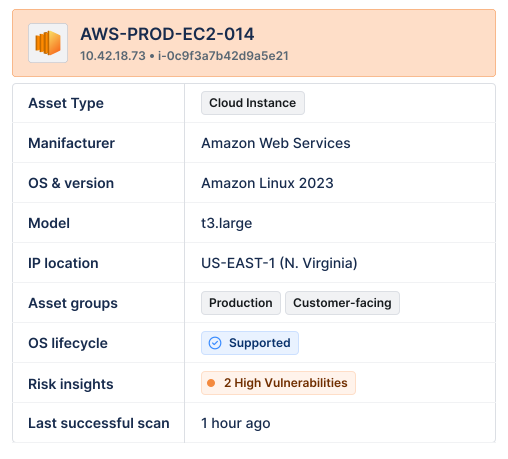
Servers, workstations, network equipment and managed or unknown assets.
A strategy suited to industrial and segmented environments, prioritizing safe, controlled discovery.
Discovery through provider connections to incorporate cloud resources into the unified inventory.
Coverage for laptops and systems that remain outside or spend little time on the corporate network.
Discovery across multiple sources requires reconciliation, normalization, classification and governance. Add Solution structures data so that different mechanisms contribute to a coherent view, without treating quantity as synonymous with quality.
Multiple sources reveal the environment.
Records referring to the same asset are consolidated.
Names, versions, vendors and models become consistent.
Classification, relationships and purpose enrich the data.
Other processes receive more reliable information.
Lifecycle Insights helps identify hardware and software that have reached or are approaching EOL and EOS. Vulnerability Insights adds vulnerability context to identified assets and software — without replacing a scanner, EDR, SIEM or patch management. The availability of Lifecycle Insights, Vulnerability Insights and SAM depends on the deployment model, plan and add-ons purchased; a detected installation does not prove a licensing violation.
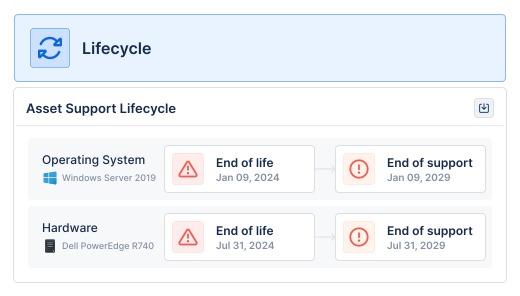
Support for planning, replacement, prioritization and risk discussions.
Vulnerability context linked to software and asset inventory.
Versions, vendors, installations, normalization and lifecycle for better-informed decisions.
End of support should not be discovered during an incident.
APIs, webhooks, integrations and workflows can feed systems and processes that depend on asset data. The architecture defines how Lansweeper can enrich CMDB, ITSM, Service Desk, security, BI, reporting and automation without assuming it replaces all these platforms. The availability and limits of APIs, webhooks and integrations depend on the current deployment model and plan.
Discovery and normalized data.
Interfaces for querying and synchronization.
More current data for service processes.
Asset context for prioritization.
Information integrated into analysis and action.
Our work starts with the environment and objectives, not with installing a scanner. Networks, sites, cloud, endpoints, OT, security, existing sources, CMDB and ITSM guide the strategy and architecture.
Lansweeper builds context about existing assets. Zabbix observes behavior, availability and performance. The conceptual combination can enrich the operational view without assuming mandatory or native integration.
What exists?
What do we know about it?
How is it behaving?
What needs attention?
Add Solution can assess your discovery, inventory and Asset Intelligence strategy, identifying visibility gaps and opportunities to integrate with existing processes.
Add Solution connects technology, architecture and processes so the data found is useful to the teams and systems that depend on it.
Discovery designed around networks, segmentation, cloud, mobility, OT and security.
Classification and governance aligned with needs and processes.
Data available to the systems that use the information.
Knowledge of networking, infrastructure, cloud, observability, security and enterprise environments.
Review of the platform and discovery mechanisms as the environment changes.
Answers about discovery, credentials, reconciliation, CMDB, deployment models and sizing.
No. There are network-based, agent-based and connector-based methods. The choice depends on connectivity and required data. Endpoints outside the network may benefit from an agent. The architecture must distinguish IT Agent Discovery from Classic components. See methods (https://docs.lansweeper.com/docs/find-all-your-assets).
Partial identification is possible through credential-free techniques, depending on the device and visibility. Detailed data requires compatible access. The pilot must document which information is missing rather than present every discovery as equally complete. Check the requirements (https://docs.lansweeper.com/docs/create-discovery-credentials).
It depends on the segments and traffic accessible to the sensor. Silent devices or those outside that visibility may not be detected. Coverage must be demonstrated using the actual topology and a known sample. Understand visibility (https://docs.lansweeper.com/docs/configure-network-visibility).
It combines evidence from different sources, but incomplete or repeated identifiers may require analysis. Check the version, provenance and timestamps of records and retain examples for diagnostics. See the conditions (https://docs.lansweeper.com/docs/understand-the-reconciliation-engine).
Inventory is an important input. The conclusion also depends on acquired rights, contracts and applicable metrics. SAM features have their own scope and purchasing requirements. See the SAM add-on (https://www.lansweeper.com/product/sam/).
Integrations exist, but availability in the deployment model and plan must be checked, and identities and field ownership must be mapped. A synchronization test must preserve data maintained by the current process. Compare integrations (https://docs.lansweeper.com/classic/docs/comparing-lansweeper-platform-and-lansweeper-classic).
It is not prudent to assume a seamless migration. Documentation describes management changes involving reinstallation and loss of data and configurations. Assess the specific procedure before executing any stage. See deployment models (https://docs.lansweeper.com/classic/docs/lansweeper-installation-and-management-types).
Prepare estimated asset counts by category, locations, cloud resources, industrial segments, existing tools and inventory objectives. Do not send passwords or sensitive diagrams through a public form. The technical count must be reconciled with the commercial metric. See the asset definition (https://docs.lansweeper.com/classic/docs/assets-that-count-toward-your-licensed-asset-limit).
Talk to our specialists about discovery, inventory, Asset Intelligence and integrating Lansweeper into your organization's technology processes.