
MHO-175
Maestro orchestrator with 32 QSFP28 ports and a 3.2 Tbps fabric for higher-density 100 GbE architectures.
Overview
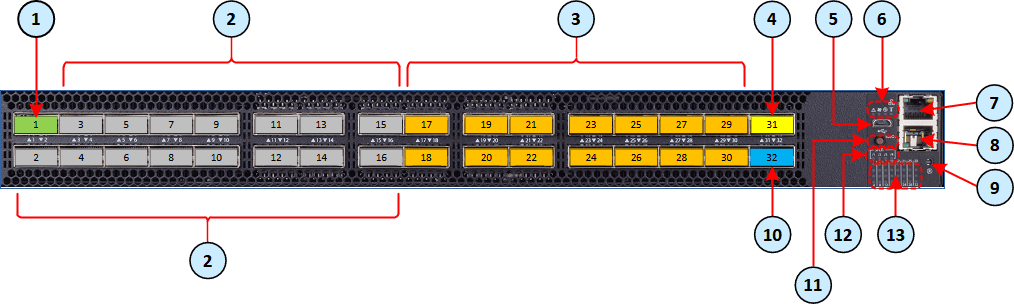
The MHO-175 provides 32 QSFP28 interfaces in 1U to connect networks and members of Maestro Security Groups. It is an option for projects with more 40/100 GbE links or a need to split ports into lower-speed logical interfaces. All 32 ports support breakout according to the guide, providing up to 128 logical interfaces. The system distributes traffic to firewalls and allows cluster expansion, while threat prevention capacity remains determined by the gateways. Redundant installations must reserve synchronisation links and use orchestrators of the same model. Selection criteria: Choose this model when the project requires higher QSFP28 density: 32 physical ports and a 3.2 Tbps fabric. Use breakout capabilities with a port budget for production, management and synchronisation; 128 logical interfaces do not mean 128 gateways. Validate redundant pairs, firewall models, DACs/optics and software version before finalising sizing.
Key features
- Breakout QSFP28 para SFP28Breakout of one QSFP28 port into four SFP28 interfaces is supported on all ports 1–32. Source: https://sc1.checkpoint.com/documents/Appliances/GSG_Maestro/EN/Topics/Splitting-Ports-with-Breakout-Cables.htm
- Synchronisation on designated subportsSynchronisation mapping is preserved on the designated subports when breakout is used on ports 31 and 32. Source: https://sc1.checkpoint.com/documents/Appliances/GSG_Maestro/EN/Topics/Splitting-Ports-with-Breakout-Cables.htm
- HyperSync traffic distributionHyperSync orchestration for traffic distribution and expansion of the firewalls in the cluster. Source: https://www.checkpoint.com/quantum/maestro-hyperscale-network-security/
- Unified management per Security GroupIndependent groups appear in SmartConsole as a Single Management Object, with a common policy for their members. Source: https://www.checkpoint.com/resources/datasheet-4532/datasheet-maestro-hyperscale-orchestrator-140-175
Technical specifications
| Fabric capacity | 3.2 Tbps |
|---|---|
| Port-to-port latency | 400 ns — MHO-175-specific table |
| Physical connectors | 32 QSFP28 |
| Speeds listed in the 10/09/2026 datasheet | 32 × 40/100 GbE or up to 128 × 10/25 GbE via breakout |
| Form factor | 1U |
| Hardware redundancy | 2 hot-swap power supplies, 1+1; 6 hot-swap fans, N+1 |
| Control hardware | 32 GB DDR4; 120 GB SSD |
Figures published by the manufacturer. Final sizing depends on the environment, enabled services and traffic profile.
Documents and references
- Complex projects require more than knowledge of a single technology.
- Better decisions begin with a better understanding of the environment.
- The network that connects the business must be ready to support it.
- Cloud is not where the infrastructure is. It is how it was architected to operate.
- Connectivity is necessary. Controlling every communication is security.
- Security designed to protect what keeps your business running.
- Maestro Hyperscale Firewall 140/175 — datasheet, revision 10/09/2026
- MHO-175 — hardware specifications
- Maestro — installation guide
- MHO-175 — panel and port functions
- Official manufacturer page