
MHO-140
1U Maestro orchestrator with 48 SFP28 ports and eight QSFP28 ports to distribute traffic across compatible firewalls.
Overview
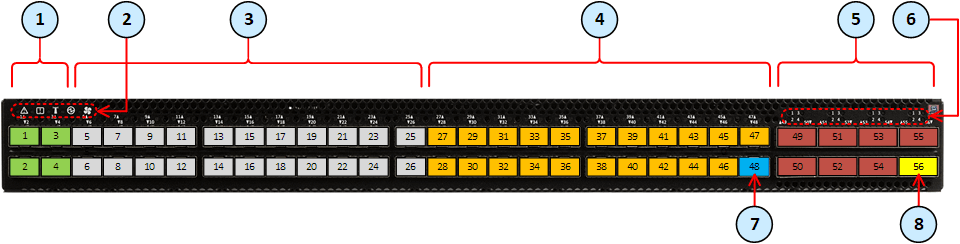
The MHO-140 connects networks and firewalls in a Maestro environment, distributing traffic among Security Group members. Its mixed panel combines many SFP28 interfaces with eight QSFP28 interfaces, supporting projects with numerous links and a portion of higher-speed connections. Groups retain their own policies and appear to management as logical entities. Inspection depends on the connected firewalls; the published 2 Tbps figure for the orchestrator represents fabric capacity. The design must reserve ports for management, synchronisation and redundancy in addition to production links. Selection criteria: Consider this model when the density of 48 SFP28 interfaces and eight QSFP28 interfaces is a better match for the project links. Plan two units of the same model for full redundancy, with gateway capacity validated separately. When using breakout on ports 49, 51, 53 and 55, account for the corresponding lower ports becoming unavailable. Validate approved speeds, transceivers and software; do not mix 10G and 25/40/100G downlinks on the same firewall.
Key features
- HyperSync traffic distributionTraffic distribution across firewalls using HyperSync technology, with expansion through cluster members. Source: https://www.checkpoint.com/quantum/maestro-hyperscale-network-security/
- Isolation through Security GroupsSecurity Groups with their own policies and interfaces, managed as a single object per group. Source: https://www.checkpoint.com/resources/datasheet-4532/datasheet-maestro-hyperscale-orchestrator-140-175
- Breakout on supported portsBreakout is supported only on the designated QSFP28 ports and requires planning for adjacent ports. Source: https://sc1.checkpoint.com/documents/Appliances/GSG_Maestro/EN/Topics/Splitting-Ports-with-Breakout-Cables.htm
- Orchestrator configuration and managementFirst-time configuration wizard in R82 or later; orchestrator management through its own interface. Source: https://sc1.checkpoint.com/documents/Appliances/GSG_Maestro/EN/Topics/Getting-Started.htm
Technical specifications
| Fabric capacity | 2 Tbps — current guide and datasheet dated 10/09/2026 |
|---|---|
| Port-to-port latency | 300 ns — datasheet table |
| Physical connectors | 48 SFP28 + 8 QSFP28 |
| Speeds listed in the 10/09/2026 datasheet | 48 × 10/25 GbE and 8 × 40/100 GbE; check the compatibility matrix |
| Form factor | 1U; 438 × 436 × 43.8 mm (W × D × H) |
| Hardware redundancy | 2 hot-swap power supplies, 1+1; 4 hot-swap fans, N+1 |
| Power consumption according to the hardware guide | 165 W typical with passive cables; 265 W maximum with optics under the published conditions |
Figures published by the manufacturer. Final sizing depends on the environment, enabled services and traffic profile.
Documents and references
- Complex projects require more than knowledge of a single technology.
- Better decisions begin with a better understanding of the environment.
- The network that connects the business must be ready to support it.
- Cloud is not where the infrastructure is. It is how it was architected to operate.
- Connectivity is necessary. Controlling every communication is security.
- Security designed to protect what keeps your business running.
- Maestro Hyperscale Firewall 140/175 — datasheet, revision 10/09/2026
- MHO-140 — hardware specifications
- Maestro — installation guide
- Maestro — breakout rules
- Official manufacturer page