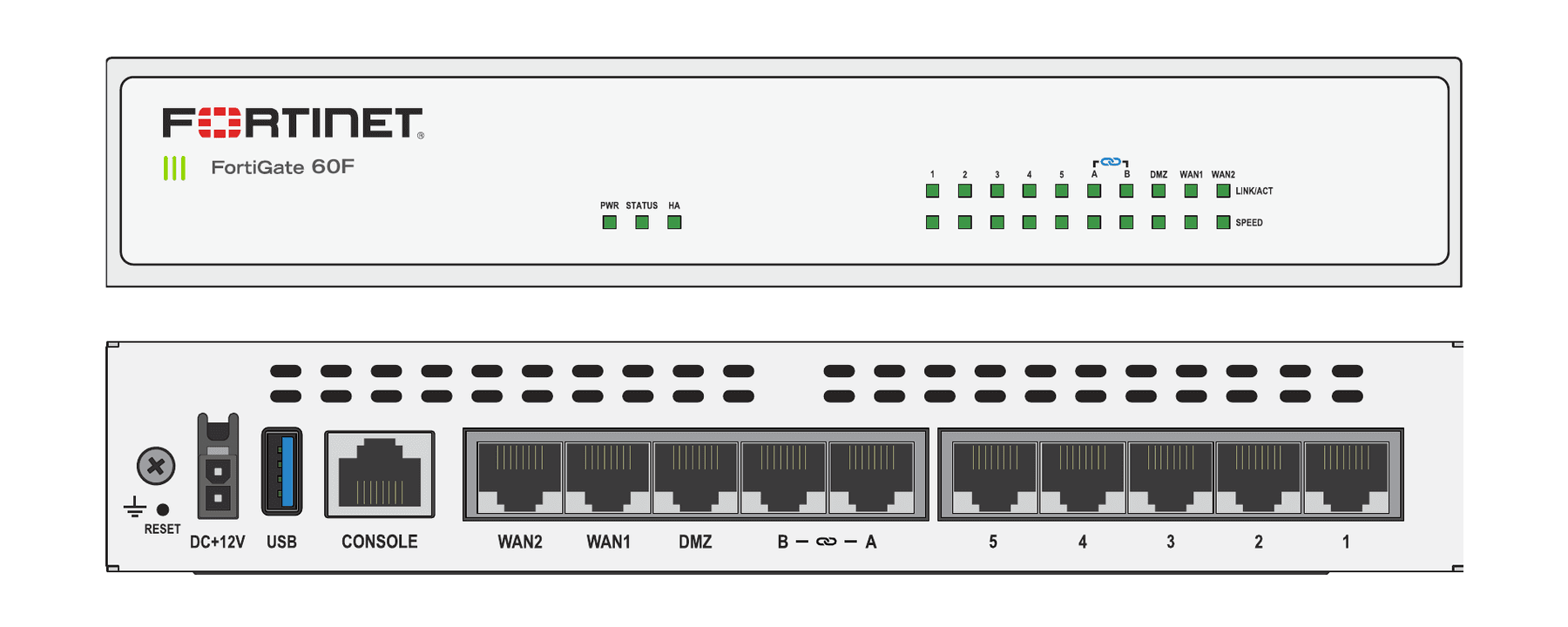
FortiGate 60F integrates network security and connectivity through FortiOS. Model selection should consider actual traffic, SSL inspection, FortiGuard services, VPN, high availability and environment growth.
Key features
Published performanceMaximum figures from the official Fortinet matrix for July 2026.
Engineering-based sizingFinal sizing accounts for active services, topology, redundancy and expansion.
Security FabricIntegration with the Fortinet ecosystem according to the defined architecture.
Technical specifications
Interfaces and hardware
RJ45 GE WAN / DMZ
2 / 1
GE RJ45 portas internas
5
GE RJ45 FortiLink ports (default)
2
Integrated Wi-Fi
Dash in the datasheet: feature not listed for this SKU
USB
1
Console (RJ45)
1
Local storage
FG-60F: no local data SSD is listed. Variant FG-61F: 128 GB SSD.
Dedicated TPM
Dash in the datasheet: feature not listed for this SKU
Bluetooth Low Energy (BLE)
Dash in the datasheet: feature not listed for this SKU
Physical signed-firmware switch
Dash in the datasheet: feature not listed for this SKU
Hardware acceleration
SP4
SFP/SFP+/QSFP and DAC on the base SKU
No optical slot is listed for the FG-60F; RJ45 GE data ports (1 Gbps).
Dedicated Ethernet management
No dedicated Ethernet management port is listed; separate console.
PoE, Wi-Fi and cellular connectivity
No PoE, Wi-Fi or 5G modem is listed for the FG-60F.
Data ports — configuration
10 × RJ45 GE (1 Gbps): 2 WAN, 1 DMZ, 5 internal ports and 2 FortiLink.
Performance
IPS
1,4 GbpsEnterprise Traffic Mix; logging enabled. Manufacturer laboratory results; actual performance varies with configuration and traffic. Throughput is advertised as a maximum (up to).
NGFW
1 GbpsEnterprise Traffic Mix; firewall, IPS and Application Control enabled; logging enabled. Manufacturer laboratory results; actual performance varies with configuration and traffic. Throughput is advertised as a maximum (up to).
Threat Protection
700 MbpsEnterprise Traffic Mix; firewall, IPS, Application Control and Malware Protection enabled; logging enabled. Manufacturer laboratory results; actual performance varies with configuration and traffic. Throughput is advertised as a maximum (up to).
Firewall — UDP 1518/512/64 bytes
10/10/6 GbpsLaboratory results; actual performance varies with configuration and traffic. UDP packets of the sizes specified in the metric.
Firewall latency — UDP 64 bytes
3.3 μsLaboratory results; actual performance varies with configuration and traffic. UDP packets of the sizes specified in the metric.
Packet forwarding
9 MppsLaboratory results; actual performance varies with configuration and traffic.
IPsec VPN — throughput (512 bytes)
6,5 Gbps512-byte packets; AES256-SHA256 encryption. Manufacturer laboratory results; actual performance varies with configuration and traffic. Throughput is advertised as a maximum (up to).
SSL-VPN — historical throughput
900 MbpsPublished historical capacity; SSL-VPN tunnel mode was removed from all models as of FortiOS 7.6.3 and replaced by IPsec VPN. SSL inspection is a separate function.
SSL inspection — throughput
630 MbpsIPS; average across HTTPS sessions with different cipher suites. Manufacturer laboratory results; actual performance varies with configuration and traffic. Throughput is advertised as a maximum (up to).
SSL inspection — new connections/s
400IPS; average across HTTPS sessions with different cipher suites. Manufacturer laboratory results; actual performance varies with configuration and traffic. Throughput is advertised as a maximum (up to).
SSL inspection — concurrent sessions
55 000IPS; average across HTTPS sessions with different cipher suites. Manufacturer laboratory results; actual performance varies with configuration and traffic. Throughput is advertised as a maximum (up to).
Application control — HTTP 64 KB
1,8 GbpsHTTP 64 KB; logging enabled. Manufacturer laboratory results; actual performance varies with configuration and traffic. Throughput is advertised as a maximum (up to).
CAPWAP — throughput (HTTP 64 KB)
8 GbpsHTTP 64 KB. Manufacturer laboratory results; actual performance varies with configuration and traffic. Throughput is advertised as a maximum (up to).
IPv6 firewall — performance
No separate IPv6 value is published in the datasheet consulted.
200Published historical capacity; SSL-VPN tunnel mode was removed from all models as of FortiOS 7.6.3 and replaced by IPsec VPN. SSL inspection is a separate function.
VDOMs — default / maximum
10 / 10
Managed FortiSwitches — maximum
24
Managed FortiAPs — total / tunnel
64 / 32
FortiTokens — maximum
500
High availability
Active-Active, Active-Passive, Clustering
Installation and power
Dimensions (H × W × D), inches
1.5 x 8.5 x 6.3
Dimensions (H × W × D), mm
38.5 x 216 x 160 mm
Weight
2.23 lbs (1.01 kg)
Form factor and mounting
Desktop
Power input
12Vdc, 3A
Power supply
External DC adapter, 100–240V AC, 50/60 Hz
Maximum current
100Vac/1.0A, 240Vac/0.6A
Power consumption — average / maximum
10.17 W / 12.43 W
Heat dissipation
42.4 BTU/hr
Operating temperature
32°F to 104°F (0°C to 40°C)
Storage temperature
-31°F to 158°F (-35°C to 70°C)
Humidity
10% to 90%, non-condensing
Noise
Sem ventoinha 0 dBA
Operating altitude
Up to 7400 ft (2250 m)
Compliance
FCC, ICES, CE, RCM, VCCI, BSMI, UL/cUL, CB
Certifications
USGv6/IPv6
Power supply redundancy
The datasheet describes an external DC adapter; it does not specify a redundant power supply configuration for the base SKU.
Licensing and lifecycle
FortiGuard licensing and support
FortiGuard services and FortiCare support depend on the purchased bundle or subscription; hardware alone does not imply that all services are included.
SSL-VPN and FortiOS version
Published historical capacity; SSL-VPN tunnel mode was removed from all models as of FortiOS 7.6.3 and replaced by IPsec VPN. SSL inspection is a separate function.
Lifecycle and document review
End of Order / End of Support are not stated in this datasheet; confirm the official milestones for each SKU before purchasing.
Service restrictions by model
CDR, Video Filtering and Inline CASB are unavailable on this series as of FortiOS 7.4.4.
Figures published by the manufacturer. Final sizing depends on the environment, enabled services and traffic profile.